
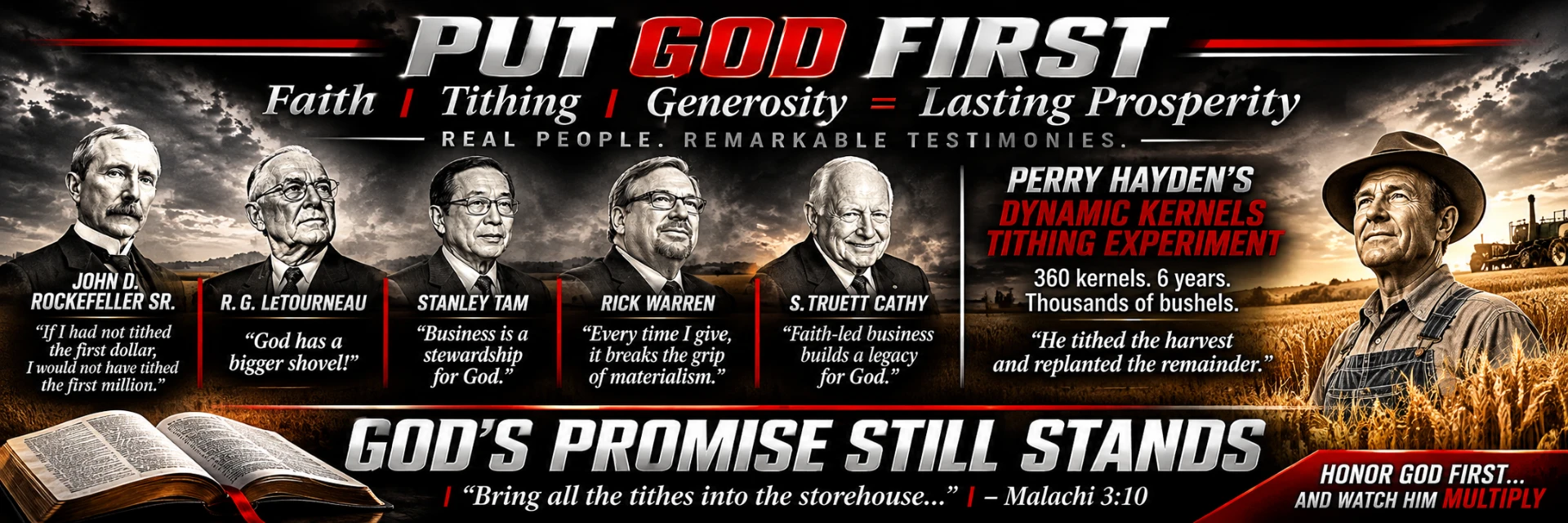
What happens when a person makes honoring God a priority—not just in words, but in the way they handle money, conduct business and approach everyday decisions?
Throughout modern history, some people built extraordinary businesses and became known for remarkable generosity. Some began giving when they had very little. Others eventually dedicated most of their income, or their business’s dividends, to Christian work.
Their stories are worth examining. Putting God first is a principle of faith, stewardship, obedience and generosity—not merely a financial transaction.
These stories do not mean everyone who tithes will become a millionaire, nor that God can be manipulated through giving. This is religious teaching, not financial advice, an investment, a lottery or a get-rich-quick offer. No income or financial result is promised or guaranteed. Giving is voluntary; never borrow to give or give money needed for your obligations.
“Honour the LORD with thy substance, and with the firstfruits of all thine increase: So shall thy barns be filled with plenty, and thy presses shall burst out with new wine.”
Proverbs 3:9–10 · KJV
The centerpiece · Tecumseh, Michigan · 1940–1946
Perry Hayden’s
Dynamic Kernels Experiment
A small beginning. A deliberate commitment. A harvest that reached far beyond one field.
In 1940, Quaker businessman and mill executive Perry Hayden began an agricultural experiment inspired by John 12:24: a grain of wheat, planted in the earth, can bring forth much fruit. He planted 360 kernels in a plot just four feet by eight feet.
His commitment was straightforward: plant the wheat, harvest it, give one-tenth to his church, and replant the remaining nine-tenths. Repeat with each successive harvest. He called it the Dynamic Kernels Experiment.
From a garden plot to a community undertaking
The beginning: 360 kernels planted in a four-by-eight-foot plot.
TIME reported a third harvest of 26 bushels. Henry Ford and Michigan’s agriculture commissioner visited the project.
The project reached 230 acres. TIME anticipated approximately 5,060 bushels in the coming harvest—an estimate, not a final measured yield.
As the project expanded, Henry Ford supplied land and assistance. What began with a handful of seeds became a nationally reported story, combining an annual commitment to giving with reinvestment, agricultural work and outside support.
The giving was part of every harvest
The tithe was not an afterthought once the project became large. It was built into Hayden’s plan from the first planting. His later retrospective account appeared in the June 1954 issue of The Voice of Healing, under “The Lord’s Work … Henry Ford and I.”
The supplied draft also describes a later total of 5,555 bushels, a hospital gift and seed distributions to other farmers. Those additional details have not been confirmed from the original scan here, so they are not presented as established totals. The contemporary TIME reports support the experiment’s expansion and its tithing practice.
Agricultural growth involved farming, growing conditions, additional land, equipment and Ford’s support. The historical record cannot independently establish that supernatural intervention caused the harvests; this is a historical illustration, not a controlled financial experiment or a prediction for your giving.
The takeaway: begin with what you have, honor your commitment to give, reinvest responsibly and let generosity extend beyond yourself.
Five remarkable lives
Faith expressed through financial decisions.
01 · John D. Rockefeller Sr.
Rockefeller’s story links extraordinary business success with a long philanthropic legacy. Raised in a Baptist household, he developed habits of church giving and charitable support long before the full scale of his fortune emerged. His later philanthropy supported education, medicine, scientific research and religious institutions.
The “first dollar / first million” quotation shown in the artwork is widely attributed to Rockefeller, but its original source is not firmly established. It is not treated here as an authenticated quotation.
The takeaway: don’t wait until you have more to honor God with what you already have.
02 · R. G. LeTourneau
LeTourneau developed massive earthmoving equipment used in construction and infrastructure. But his legacy includes more than machinery: he viewed business as a way to serve God, support missions and create opportunities for Christian education.
The Texas State Historical Association records that he dedicated 90% of his company stock to the LeTourneau Foundation. His autobiography, Mover of Men and Mountains, recounts his faith and business journey.
The documented stock commitment is distinct from company revenue or an audited annual personal-income percentage. The “bigger shovel” saying is associated with his giving philosophy, not a promise of returns.
The takeaway: financial increase creates an opportunity for increased generosity—not merely greater accumulation.
03 · Stanley Tam
Tam’s story is an unusual example of Christian business stewardship. He understood his business as something entrusted to him by God, rather than something belonging exclusively to himself.
According to U.S. Plastic’s company history, Stanley and Juanita Tam established the Stanita Foundation in 1940 and gave it 51% ownership. In 1955, they transferred the remaining interest, bringing the foundation’s ownership to 100% and dedicating dividends to Christian work.
The legal owner was a foundation; “God owns my business” expresses Tam’s religious understanding of that decision. It is ownership and dividends—not a claim that every dollar of revenue was given away.
The takeaway: approach businesses, careers and resources as responsibilities entrusted to you.
04 · Rick Warren
Warren and his wife Kay described starting their marriage by giving 10% and increasing their giving over time. In his first-person interview on “reverse tithing,” Warren said they gave away 90% and lived on 10%.
This is their reported practice at the time of the interview, not an independently audited lifetime statistic. The heart of his testimony is generosity as a discipline that loosens the hold of materialism—not giving as a method of buying wealth.
The takeaway: generosity is a spiritual discipline as well as a financial decision.
05 · S. Truett Cathy
Cathy built his business around publicly stated biblical convictions. The company’s purpose includes glorifying God through faithful stewardship of everything entrusted to it.
Its Sunday closure gave employees a day for rest, family and worship if they chose. His example shows that faith can influence business hours, employee treatment, ethical decisions and service—not only donations.
Cathy is included as an example of Christian stewardship, not as a independently verified lifelong 10% tithing testimony. The wording in his portrait is a thematic summary, not an authenticated quotation.
The takeaway: faith should influence how you earn money as well as how you give it.
Different lives · One recurring conviction
The biblical principle: put God first.
Their circumstances and outcomes were different. But the same themes return: faithfulness, surrender, responsibility and generosity.
- RockefellerFaithfulness in the little things.
- LeTourneauIncreasing generosity.
- TamSurrendering ownership.
- WarrenBreaking materialism.
- CathyConviction over convenience.
- HaydenStarting small and making giving part of every harvest.
Five passages to consider
Proverbs 3:9–10: Honor the Lord with your substance and the firstfruits of your increase.
Malachi 3:10: Bring the tithe into the storehouse; God invites His people to prove Him in this.
Luke 6:38: Jesus teaches giving with a picture of good measure, pressed down and running over.
Matthew 6:33: Seek God’s kingdom and righteousness first, trusting Him for provision.
2 Corinthians 9:6–8: Sow generously, give willingly rather than under pressure, and remember that God loves a cheerful giver.
These are summaries of the passages, not direct quotations. Sincere Christians differ on how the Old Testament tithe applies under the New Covenant; the call to generosity, faithful stewardship and putting God first remains unmistakable.
Never make money your master.
Perhaps the greatest lesson is not how much these individuals accumulated. It is what they chose to do with what was entrusted to them. Different lives. Different circumstances. One recurring conviction: what we have should never become more important than the One who gave us life.
Put God first. Honor Him with your increase. Practice generosity. Remain faithful.
Read the record
Historical sources & context
Contemporary reporting, company histories and personal testimony are different kinds of evidence. None establishes that giving guarantees a financial outcome. The artwork is inspirational illustration—not documentary evidence.
- TIME: Parable Proved · July 26, 1943 ↗
The initial planting, third harvest and Ford’s visit. - TIME: Dynamic Kernels · July 30, 1945 ↗
The 230-acre field and anticipated harvest, not a final total. - The Voice of Healing · June 1954 ↗
Hayden’s retrospective account begins on page 4; the additional totals in the supplied draft remain unconfirmed here. - U.S. Plastic: How We Reached 100% ↗
The company’s account of the Tam family’s foundation ownership transfers. - Texas State Historical Association: LeTourneau ↗
His inventions, foundation and dedication of company stock. - Rick Warren: What is a reverse tithe? ↗
First-person interview describing his and Kay’s giving practice. - Chick-fil-A: Culture and values ↗
Biblical stewardship purpose and Sunday closure. - Rockefeller Archive Center ↗
Historical collections on the family and philanthropy; the artwork’s quotation is not authenticated here.